• About Us
  • Board of Advisors
  • Contact

MALARIA.com

A Malaria Information and Community Portal

  • Home
  • Malaria Overview
  • Malaria Research
  • News
  • Videos
  • Blogs
  • Malaria Q&A
  • Events
  • Jobs
Home / Malaria Q&A / Malaria in Africa

Malaria in Africa

January 8, 2012 By Malaria Q&A Leave a Comment

QUESTION

What percent of Africa has malaria?

ANSWER

That is very difficult to measure, but maps of malaria transmission potential show that malaria is potentially present across most of the continent, excluding the heart of the Sahara and Kalahari deserts, and the highlands of Ethiopia, Lesotho and Uganda/Rwanda. Other parts of the continent, such as the coastline of North Africa (along the Mediterranean) and much of South Africa and Zimbabwe likely only experiences seasonal transmission of malaria, with some parts of the year too cold and/or dry to support transmission. The below map shows the distribution of malaria throughout Africa, and should give you some idea of the percentage landcover that is affected.
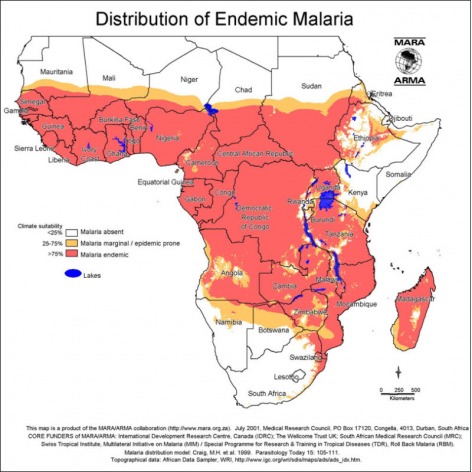
Distribution of endemic malaria

Distribution of endemic malaria in Africa. Picture courtesy of http://siteresources.worldbank.org/NEWS/Images/malaria-map.jpg

Filed Under: Malaria Q&A Tagged With: Africa, endemic transmission, Malaria distribution, seasonal transmission, World Bank

Leave a Reply Cancel reply

You must be logged in to post a comment.

This site uses Akismet to reduce spam. Learn how your comment data is processed.

Stay Informed

WWARN Corner

About WWARN

The WorldWide Antimalarial Resistance Network (WWARN) generates innovative resources and reliable evidence to inform the malaria community on the factors affecting the efficacy of antimalarial medicines. Learn more…

  • Fighting Malaria Requires Protecting the Effectiveness of Antimalarial Medicines
  • Data Sharing at IDDO
  • Evidence to inform equitable dosing in very young and malnourished children

More WWARN Stories...

Five Things You Might Not Know About Medicine Quality

The proliferation of poor quality medicines has been described as a global pandemic that threatens the lives of millions.1 It stands to reason that poor quality medicines are not going to improve anyone’s health, but how much do we really know about the quality of medicines used across the world? Here we examine five issues relating to medicine quality in an effort to show why we should all be paying more attention to a serious public health issue that is difficult to tackle and not yet fully understood.

How Can We Detect Poor Quality Medicines?

Finding out what medicines contain and investigating their packaging are vital steps in the fight against poor quality medicines, both substandard and falsified. Falsified medicines usually masquerade as real medicines by copying the appearance and packaging of the real product, but may not contain any of the same active ingredients, or in the correct amounts.

Challenges in Tackling the Issue of Poor Quality Medicines

There are many unresolved issues that impede the elimination of poor quality medicines, namely: (1) Progress impeded by confusion over definitions; Ensuring a market free of poor quality medicines; and the lack of global criminal laws.

Editorial

Antimicrobial Resistance: The Silent Threat in Malaria Eradication

By Bernard Owusu Agyware, Arielle Dolegui and Jesus Aquilar Malaria is a serious and sometimes deadly disease, affecting millions and claiming more than  600,000 lives worldwide each year in 2022 and 2021.1 Low and Middle-Income Countries (LMICs), particularly in Sub-Saharan Africa, disproportionately bear the greatest burden of malaria. The fight to eradicate this worrisome disease […]

  • Home
  • Malaria Overview
  • Malaria Research
  • News
  • Videos
  • Blogs
  • Malaria Q&A
  • Events
  • Jobs
  • About Us
  • Board of Advisors
  • Contact

Copyright © 2026 Malaria.com · Log in